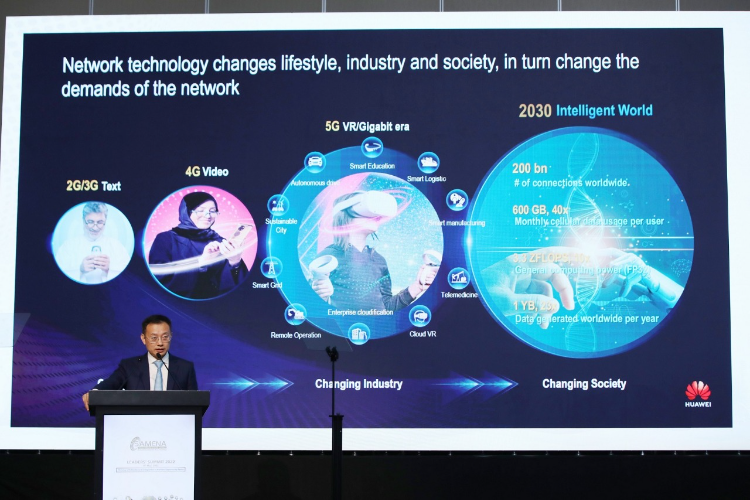

Leaders and experts from the
telecommunications industry came together at this year's SAMENA Council
Leaders' Summit hosted by Huawei for the ninth consecutive year. The annual
gathering was held under the theme of "Thriving with Resilience &
Integration in the New Opportunity Realm" and focused on the new business
opportunities that 5G and allied technologies provide for all industries and
economic sectors.
This year, Huawei shed light on the role
of 5G, cloud and digital power in tackling the sustainability needs of the
telecom industry and how an integrated intelligent ICT architecture will light
up the future. Through its 'Everything as a Service' model, Huawei highlighted
the cloud's integral role in enabling the digital economy and data sovereignty.
The Summit also focused on the opportunities gained by integrating
technologies, infrastructure investment, connectivity, and spectrum
availability, which will benefit vertical industries and economic sectors.
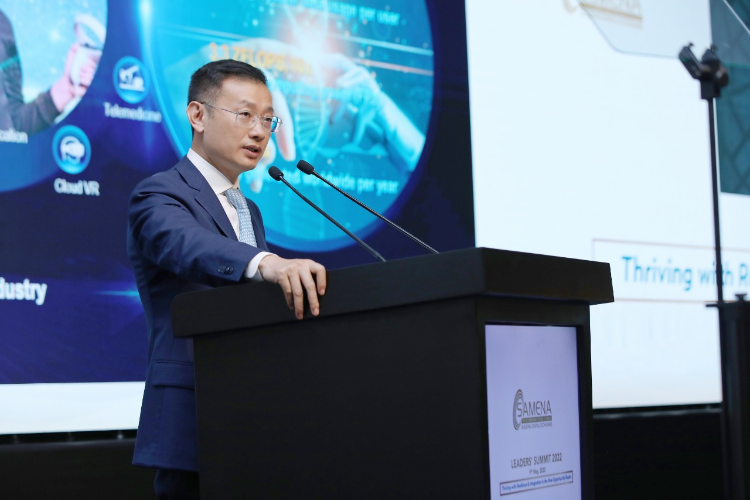
Steven Yi, President of Huawei Middle
East, highlighted the crucial role of 5G in driving digital transformation
across the region and the immense opportunities for enterprises in the 5G era.
"Digital renaissance triggered by the pandemic has pivoted digital
transformation to new heights, with 5G era infrastructure and communications
technologies taking center stage. A strong drive for digital transformation is
taking place worldwide, and Huawei is committed to bring the ingenious new
technologies that will enrich people's lives with immersive digital services
and enabling new opportunities in the industry’s digital transformation with
smart digital solutions.” Yi noted.
Bocar A. BA, SAMENA Council CEO, said,
"We held very fruitful discussions on the future direction of our
networks, particularly in the 5G era. What was apparent is the transformational
role of networks in driving digital transformation and economic growth.
Participants also agreed that networks themselves must evolve to meet the
region's sustainability goals. In this regard, the role of innovation in
enabling net-zero transition through digital power technologies is increasingly
important for the Middle East."
Vanness You, Vice President of Marketing
and Solution, Huawei Middle East, officially launched Huawei IntelligentRAN in
the region. Vanness You noted that: “Towards the future, intelligence in every
industry and connection, Huawei IntelligentRAN opens new paths to wireless
intelligence, bringing the next level of service capability including agile
service, smart experience, smart green and smart O&M.”
Additionally, IntelligentRAN allows
intelligent air interfaces to use key technologies like smart grids, scheduling
dictionaries, and channel graphs. These tools can configure air interface
resources intelligently and achieve optimal user experience and capacity.
Service prediction with IntelligentRAN also guides non-real-time spectrum and
channel selection on the network side and real-time symbol scheduling and
transmit power configuration on the base station side. This significantly
reduces energy consumption across the entire network.
Huawei Executives took part in several
panel discussions. Mohamed Madkour, VP of Wireless Networks Marketing and
Solutions at Huawei, participated in the "Leaders' Exchange Connectivity
for the New Decade" panel. He noted that intelligent connectivity is the
lifeline for everyone and integral to every country's digital economy. He
reiterated Huawei's commitment to providing powerful, intelligent, simple and
efficient digital infrastructure and operational tools to create more
commercial and social values for societies, industries and economies. He also
highlighted that growth-oriented ICT policies are key to facilitate a favorable
environment for business and technology innovations.
Emaad Ahmed, Chief Expert, Huawei Middle
East, took part in a panel discussion titled "Techno-Business Convergence
Achieving Sustainable Integration in the 5G Era." He noted that operators'
OPEX increases due to system and network complexity. Therefore, reducing OPEX
and achieving green development is essential for operators' future growth in
light of the carbon-neutral background and the demand for cost reduction and
increased efficiency.
Joined by senior executives from leading
companies in the region, Mr. Paul M. Scanlan, CTO of Carrier Network Business
Unit, Huawei, participated in "Cloud & Network Synergies: Achieving
Resilience in Service Delivery" roundtable. The executives discussed Cloud
Resilience, Hybrid-Cloud, Cloud Native Security, Multi-Cloud, Cybersecurity,
Cloud Service Models, "X2B", Cloud and Network Synergies.
The Summit also witnessed the launch of a
joint UNESCO Huawei report titled "Talent Ecosystem for Digital
Transformation: Insight Report on ICT in Higher Education and TVET (Technical
and Vocational Education) in the Middle East and Pakistan".
The report echoed the importance of
developing ICT talents and creating relevant ecosystems to enhance ICT skills
in the region and expand access to career opportunities in the digital world.
The report showed a focus on ICT skills development has resulted in high ICT
skills among the populations in the region. Data shows that 79% of individuals
in the UAE have basic ICT skills in 2019. The corresponding figure is 61% in
Saudi Arabia and 63% in Bahrain. With a legacy of developing high-quality human
capital, Jordan has 63% of individuals with basic ICT skills.